.png?width=552&height=88&name=aptitude8%20-%20standard%20-%20White%20-%20LG%20(1).png "aptitude8 - standard - White - LG (1)")
.png?width=750&height=405&name=Building%20a%20Scalable%20HubSpot%20Strategy%20(2).png)

AI agents promise to help teams work faster, respond smarter, and scale without adding headcount. But in practice, deploying AI agents across an enterprise CRM is where complexity often shows up.
Before agents can take action, they need context. They need to understand CRM data, respect permissions, and operate safely inside real workflows. Both HubSpot and Salesforce offer AI assistants and agents. The difference is how those agents are configured, governed, and deployed across teams.
The Real Enterprise AI Agent Scenario
Imagine you’re a Sales Ops or RevOps Manager rolling out AI agents to a sales team.
Leadership wants:
- AI assistance embedded directly in CRM workflows
- Context-aware recommendations for reps
- Safe automation that respects permissions and data access
- Fast deployment without months of setup
At enterprise scale, AI agents don’t live in isolation. They interact with deals, contacts, activities, and automation. If configuration is heavy or fragmented, adoption slows quickly.
The real question teams are asking isn’t can we deploy AI agents? It’s:
How fast can we deploy them and how much setup is required to do it safely?
What Enterprise Teams Actually Need From AI Agents
Before comparing platforms, it helps to define what AI agents need to support at scale.
Enterprise teams need:
- AI agents embedded directly in CRM tools
- Immediate access to full CRM context
- Clear governance over what agents can see and do
- Simple configuration without heavy provisioning
- The ability to deploy agents incrementally across teams
When agent setup is complex, AI becomes limited to small pilots instead of real adoption.
How HubSpot Configures Enterprise AI Agents
HubSpot approaches AI agents as native extensions of the CRM.
Native AI Assistants Embedded Across the CRM
HubSpot’s AI assistants are embedded directly into CRM tools where teams already work. Agents operate with full CRM context by default, using shared properties, objects, and permissions.
There’s no separate service required to connect data before agents can function.
Breeze Studio Configuration
AI agents are configured directly inside Breeze Studio.
Teams can:
- Define agent behavior and actions
- Control access through existing CRM permissions
- Deploy agents across sales, service, and marketing tools
- Extend agent actions through workflows and automation
Configuration happens inside the CRM, not across multiple systems.
Operational Impact
Because agents are native:
- No provisioning is required
- Deployment is fast
- Permissions and data access are inherited automatically
- Ops teams retain control over rollout and scope
AI agents become something teams can adopt quickly and refine over time.
How Salesforce Approaches AI Agents
Salesforce supports AI agents, but the setup path is more involved.
Enabling Einstein and Agentforce
Before agents can operate, teams must:
- Enable Einstein
- Configure Agentforce
- Connect agents to Data Cloud
- Define access rules and actions
This introduces additional steps before agents can interact with CRM data.
Data Access and Action Configuration
Agent actions often rely on:
- Flow
- Apex
- Or custom logic
Permissions and data access must be carefully configured to ensure agents behave correctly.
Operational Tradeoffs
This approach offers flexibility for complex environments, but it introduces friction:
- Longer setup timelines
- Additional licensing considerations
- Greater admin and technical involvement
- Slower initial deployment
For teams looking to move quickly, this can limit adoption.
The Hidden Cost of Agent Configuration
The real cost of AI agents isn’t intelligence, it’s activation.
Enterprise teams begin to experience:
- Delayed rollouts
- Limited pilots instead of broad adoption
- Increased dependency on technical resources
- Hesitation to expand AI usage
- Slower feedback loops
When configuration is heavy, AI momentum stalls.
When Each Platform Is the Better Fit
Both platforms can support enterprise AI agents, but they’re optimized for different approaches.
HubSpot is a stronger fit when:
- Teams want fast AI deployment
- Agents need immediate CRM context
- Ops teams control rollout and governance
- AI adoption is incremental and practical
Salesforce can be the right fit when:
- Agent behavior is deeply customized
- Dedicated technical teams manage AI
- Data Cloud is already in place
- AI initiatives are large and centrally planned
The difference isn’t intelligence,it’s accessibility.
Key Takeaway
Both HubSpot and Salesforce offer AI agents for enterprise teams.
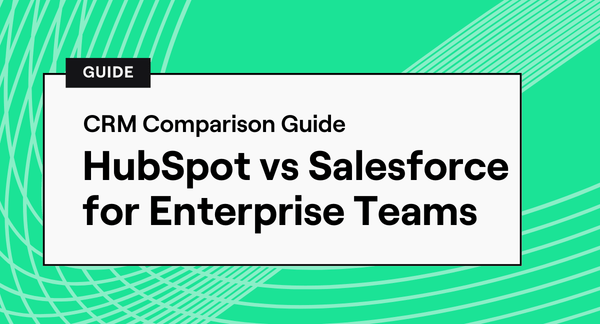
HubSpot embeds AI agents directly into the CRM, enabling fast deployment with minimal setup. Salesforce enables powerful agents through additional configuration and data-layer setup that increases flexibility but slows time to value.
At scale, that difference shows up in adoption speed, operational effort, and how quickly AI becomes part of daily work.
See how AI agents compare across every core CRM workflow in the full